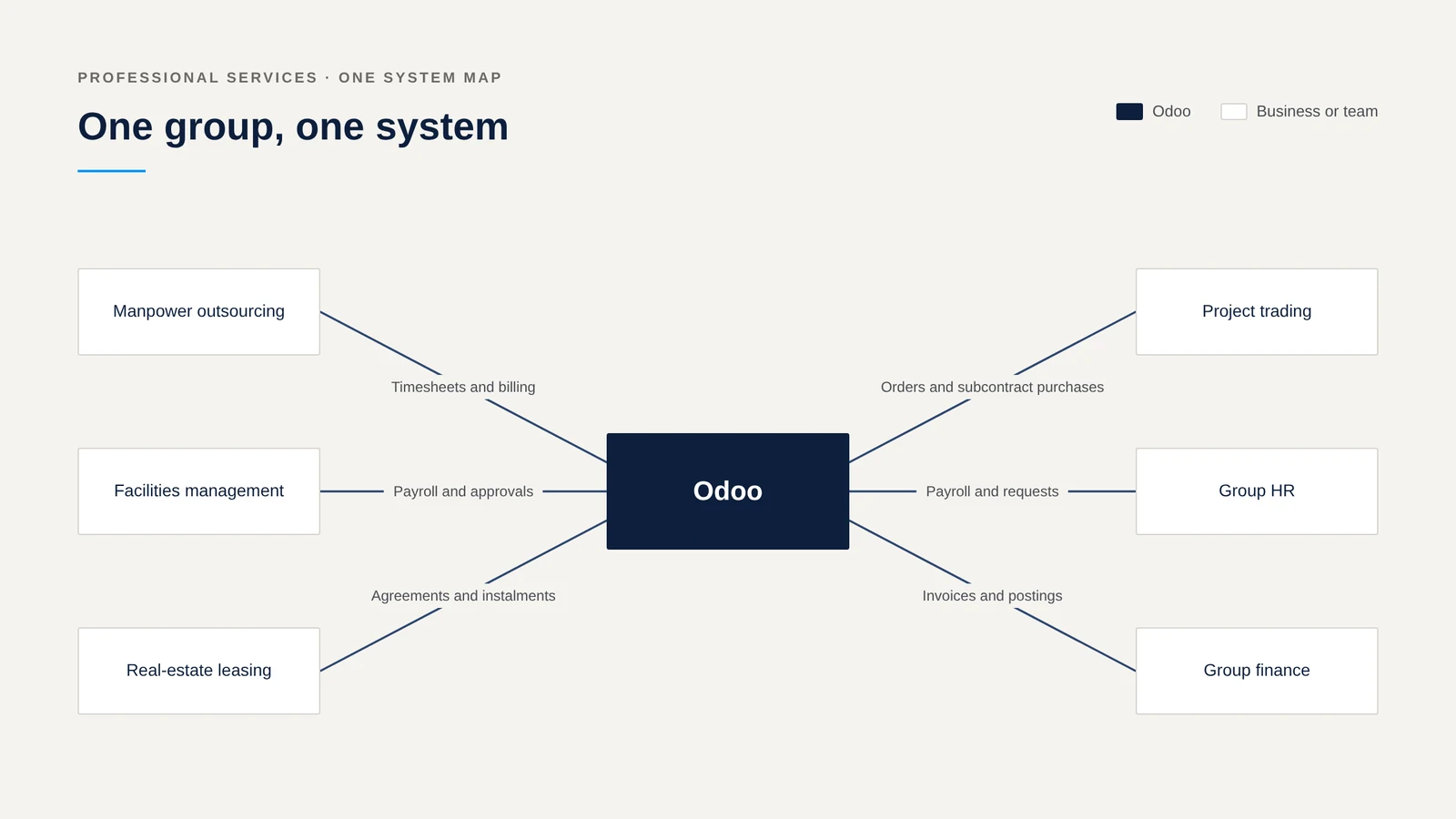
Supplying workers to a client, looking after buildings, leasing property and trading on projects are very different businesses. Al Shoumoukh does all of them in the UAE, through sister companies that share employees, HR rules and group finance. Al Jawad Software House shaped Odoo so that these companies work in one system, with approvals inside the documents, payroll that follows UAE practice, and customer billing that starts from the hours people worked.
The business
Each line of the group has its own commercial rhythm. Outsourcing bills by hours and labour category. Leasing bills by instalment. Trading follows sales orders against subcontract purchases and milestones. A separate system for each would leave the shared people and shared finance split apart, so all of it had to sit together while each company kept its own identity on paper.
Where the work gets hard
One approval route does not fit. A quotation, a goods receipt, a supplier bill and a customer payment each need different reviewers, and those reviewers change from one company to the next. If approval happens outside the document, an unapproved record can still move forward.
The employee's company may not be the paying company. In outsourcing, the company that holds a person's visa is not always the company that should carry the cost. Payroll has to reach the right books and still follow UAE rules on gratuity, which is the end-of-service payment, as well as pension and leave.
Labour is charged from timesheets. Outsourced staff are billed from their hours, at rates that vary by labour category. Billing therefore depends on loading large batches of timesheets accurately.
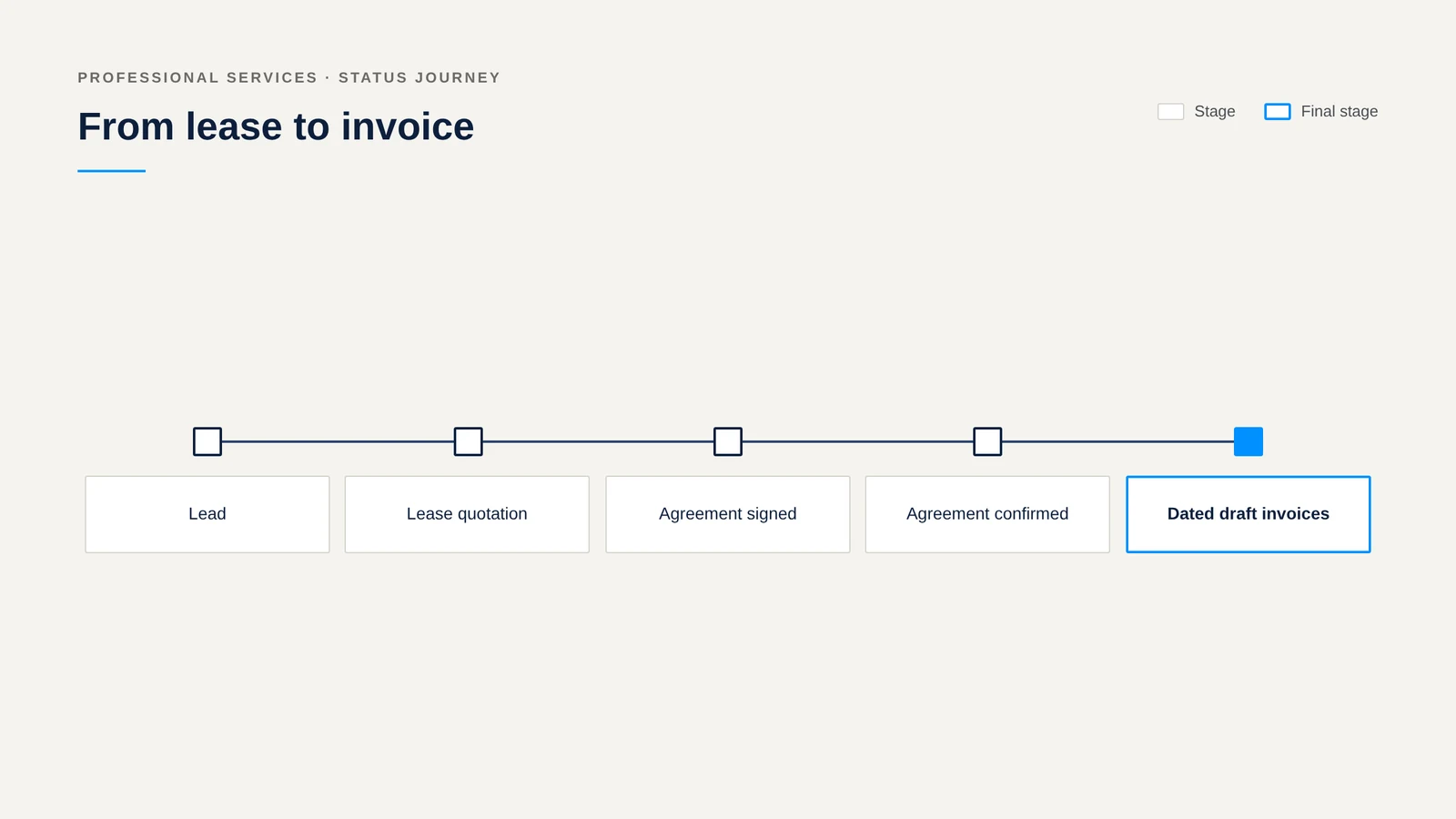
A lease is a long schedule. One signed agreement creates a series of future invoices. Those should follow from the agreement, not from someone's memory.
What we implemented
Approvals built into the documents
We built one approval process that sits inside sales, purchasing, accounting, CRM and HR documents. For each company and each type of document, the group sets the stages, the people or roles at each stage, and a shorter route for lower-value documents.
While a document waits for approval it is locked. If someone refuses it, it goes back to the previous approver to think again. It is only finally refused when no earlier approval remains, and then the person who submitted it is told. A stage that runs out of time is skipped automatically. Each user has a screen showing what is waiting for them, and approved documents print with their signature slots filled in from the approvals.
HR requests on the same logic
Loans, leave, salary increments, HR letters, expenses and recruitment requests follow the same approval logic as commercial documents.
UAE payroll that reaches the right company
Payroll covers a monthly gratuity provision, final settlements, the GPSSA pension for eligible employees, loans repaid through instalments on the payslip, air tickets, and leave encashment with its accounting entries. Salary cost is posted to the company responsible for it, even when the employee's visa sits with another company in the group.
Manpower billing from timesheets
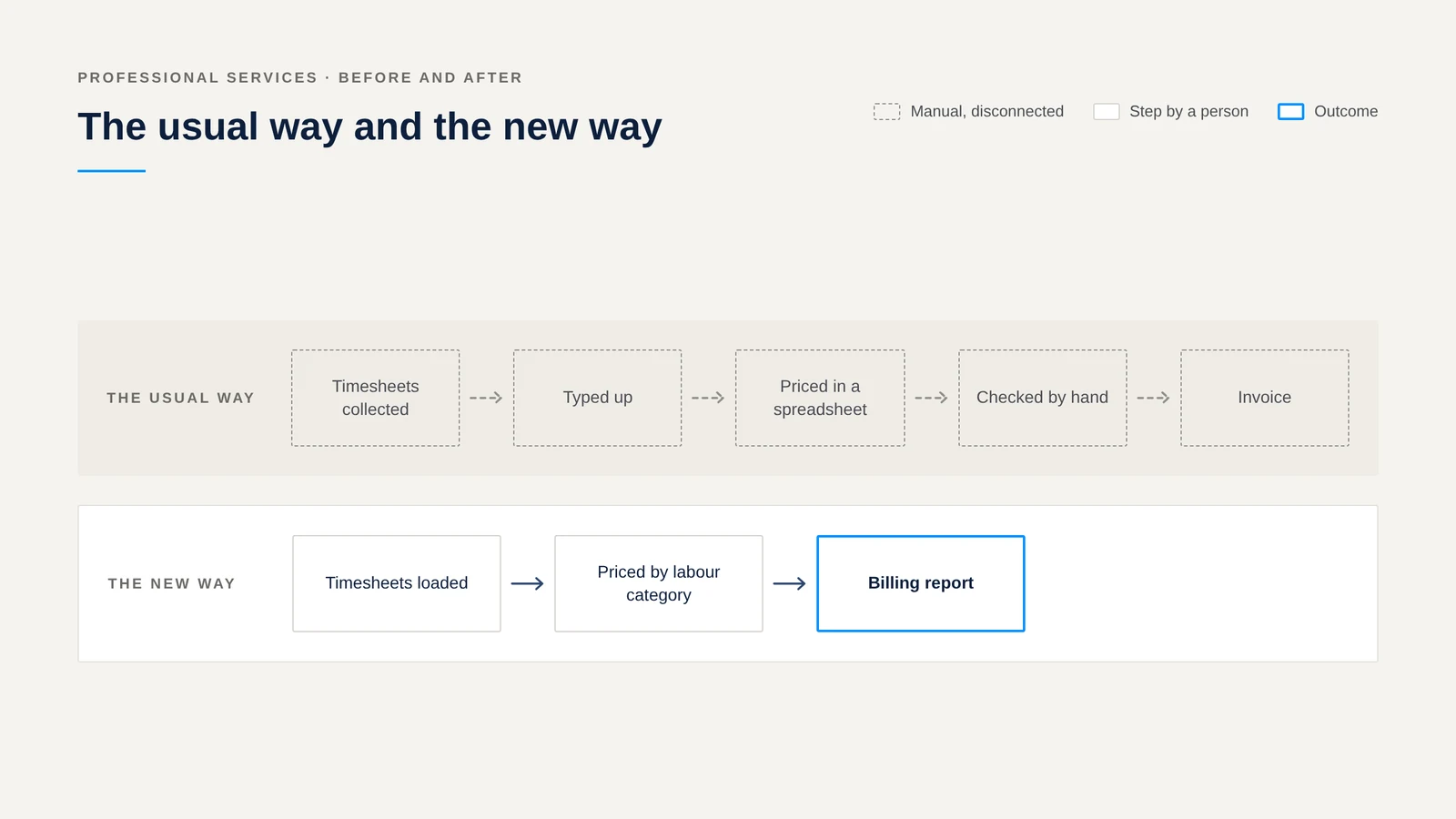
Timesheets are loaded in bulk. A billing report then applies the rates for each labour category, so hours worked become billable figures in the same system that pays those employees.
Leases from agreement to invoice
Lease agreements are held with their instalment lines and can be sent for digital signature. When an agreement is confirmed, Odoo creates a draft invoice for each instalment, dated in advance. A rental income report sits on top. On the sales side, salespeople receive reminders as a lead's expected closing date approaches.
Each company keeps its own identity
Document numbers, letterheads and tax invoices are set by company. Customers and employees see the name of the company they deal with, even though the group works in one place.
How the work gets easier
| The usual way | With the new process |
|---|---|
| Approvals are chased by message, and each company does it differently | Each document follows the route set for its company and type |
| A document can move on before anyone has signed off | The document stays locked until the approval is complete |
| A refusal sends the work back to the start | It returns to the previous approver for another look |
| Payroll cost is moved between companies by hand afterwards | Cost is posted to the responsible company as part of payroll |
| Timesheets are typed up and priced in spreadsheets | Timesheets are loaded in bulk and priced by labour category |
| Lease invoices are raised when someone remembers | Confirming the agreement creates dated draft invoices |
The result is a group where each company keeps its own rules without running its own system. Managers see what needs their decision, and finance receives documents that have already passed the right people.
Related solutions
- Odoo Custom Development
- Odoo HR and Payroll Implementation
- Multi-Company ERP
- Business Process Automation